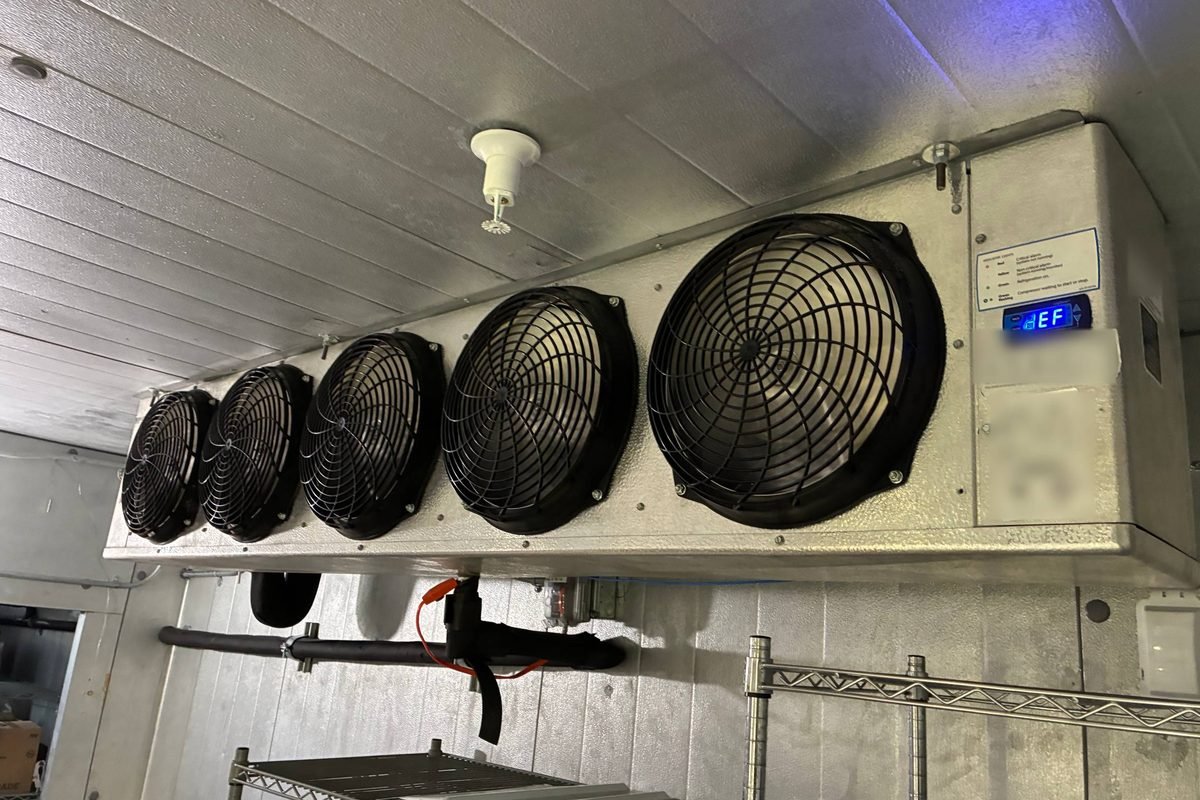
When you open your walk-in freezer and see the ceiling evaporator unit encased in solid white ice—or icicles hanging from the drain pan while box temperature climbs from 0°F toward 20°F—shutting the system down to melt the coil only clears the symptom. Unless you fix the failure that left water on the fins, that ice block will return within 48 to 72 hours.
Under Tennessee Department of Health Food Service Establishment Rules (Tenn. Comp. R. & Regs. 1200-23-01-.03(5)(a)1.) and the U.S. FDA Food Code (§ 3-501.11), stored frozen food must be maintained frozen solid. Repeated freeze-thaw swings ruin product quality, cause purge and freezer burn, and send liquid refrigerant flooding back into your outdoor compressor. Here is how to read the ice pattern on your freezer coil and what requires a commercial refrigeration technician.
Office hours 8:00 AM–5:00 PM Mon–Fri, with after-hours emergency service available.
- Keep screwdrivers, knives, ice picks, and heat guns away from the coil: Evaporator passes are thin-wall copper tubes surrounded by delicate aluminum fins holding pressurized refrigerant. One puncture vents the charge (
40 CFR § 82.154), pulls moisture into the sealed system, and forces a full coil replacement. - Do not pour buckets of hot water into a backed-up drain pan: If the condensate line is frozen inside the wall, water simply overflows onto the freezer floor and freezes into a severe slip hazard.
- Look at where the ice starts before calling: Note whether ice is heaviest around the doorway ceiling, evenly across the whole coil face, growing upward from the drain pan, or balled up on just one side of the coil.
Diagnostic Summary Table: What the Ice Pattern Tells You
Where ice forms first on the ceiling unit tells an experienced technician which subsystem failed before a single panel is removed:
| Ice Pattern You See | Primary Root Cause | Safe Owner Check | Commercial Technician Repair |
|---|---|---|---|
| Snowy frost on the ceiling near the door and across front fan guards | Warm kitchen air leaking past a split door gasket, sagging hinge, or failed closer (10 CFR § 431.306) |
Verify door latches tightly, strip curtains hang straight, and run the dollar-bill gasket test | Replace perimeter magnetic gasket, adjust/replace hydraulic door closer, and seal wall penetrations |
| Entire evaporator coil face packed evenly from top to bottom | Stalled defrost timer, open electric defrost heater rod, or failed termination thermostat | Note whether the unit ever pauses fans for a 20–30 minute defrost cycle | Test 208–240V heater amperage and continuity, replace faulty defrost timer or termination switch |
| Solid sheet of clear ice growing upward from the drain pan into the bottom fins | Frozen condensate drain line or burned-out self-regulating drain-line heat tape | Check that boxes aren't crushed against the copper/PVC drain pipe or unplugging heat tape | Thaw and clear drain line, verify slope, and install new self-regulating drain-line heater cable |
| Hard ball of ice on only one side/corner of the coil while the rest is bare | Low refrigerant charge (active leak) or restricted thermostatic expansion valve (TXV) / liquid drier | Keep door closed and call for service; manual defrost will not restore cooling capacity | Perform EPA Section 608 / AIM Act (40 CFR § 84.106) leak repair, replace drier, evacuate, and weigh in charge |
| Ice building behind one fan bay while a fan blade is stopped or dragging | Failed evaporator fan motor or ice rubbing a bent fan blade | Look through the fan guard (hands clear) to see if all fan blades spin at full speed | Replace failed evaporator fan motor, balance fan blade, and verify fan-delay relay operation |
The 5 Root Causes of Repeat Walk-In Freezer Freeze-Ups
1. Door Seal Infiltration & Unsealed Conduit Penetrations (DOE 10 CFR § 431.306)
Walk-in freezer defrost cycles are timed to clear normal frost from routine kitchen door openings—not 24/7 air leaks. Because warm kitchen air holds dramatically more moisture than 0°F freezer air, a quarter-inch gap at a torn door gasket or a missing vinyl strip curtain pours gallons of water vapor directly onto the coil every week.
- Under U.S. Department of Energy Walk-In Standards (
10 CFR Part 431 Subpart R, § 431.306), walk-in freezers require minimumR-32thermal insulation, self-closing doors, and tight perimeter seals to restrict moisture infiltration. - Even an unsealed pipe penetration where suction lines pass through the walk-in wall acts like a vacuum line, drawing humid ceiling-plenum air straight into the back of the evaporator.
2. Failed Defrost Timer or Electronic Defrost Controller
Most commercial walk-in freezers initiate an electric or hot-gas defrost every 6 to 8 hours (3 to 4 times per day). If the defrost clock motor stalls or its internal switch contacts pit and fail to transfer power, the freezer never enters defrost at all—building frost layer upon frost layer until airflow stops completely.
3. Open Electric Defrost Heater Element or Bad Termination Switch
During an electric defrost cycle, the evaporator fans stop and 208–240V resistance heater rods embedded in the coil and drain pan warm the aluminum fins above freezing. Two components govern that cycle:
- Defrost heater elements: When one heater rod burns open, part of the coil stays below 32°F and builds an unmelted ridge of ice that spreads across the entire face over the next several cycles.
- Defrost termination / fan-delay switch (klixon): Mounted directly on the coil tubing, this switch ends the heat cycle once the coil reaches roughly 50°F–55°F, and then delays the evaporator fans after refrigeration restarts until the wet coil drops back below 25°F–30°F. If it terminates early, ice never finishes melting; if its fan-delay fails, the fans blast water droplets off the wet coil across your freezer ceiling.
4. Frozen Condensate Drain Line or Failed Drain-Line Heat Tape
Because the freezer interior sits at 0°F to -10°F, meltwater leaving the evaporator drain pan will freeze solid inside the drain pipe within seconds unless the drain line is pitched properly and wrapped with working self-regulating electric heat tape under its insulation. Once the drain pipe freezes shut, water from the next defrost backs up in the pan and freezes upward into the bottom rows of coil fins.
5. Refrigerant Leak, Metering Restriction, or Dead Evaporator Fan
When only the first few passes of the evaporator coil pack with hard ice right after the expansion valve while the rest of the coil stays bare, the cause is usually a low refrigerant charge or a restricted metering device—not a defrost failure. Lower suction pressure drops the boiling temperature of the refrigerant at the coil inlet, freezing moisture solid on those first tubes while starving the rest of the coil.
- Under U.S. EPA Section 608 (
40 CFR § 82.161) and the EPA AIM Act Commercial Leak Repair Rule (40 CFR § 84.106, effective January 1, 2026), commercial refrigeration appliances with a full charge of 15 pounds or more of an HFC or substitute refrigerant (GWP > 53) require a leak-rate calculation whenever refrigerant is added and mandatory repair + verification testing within 30 days whenever the annual leak rate exceeds 20%.
- Frozen Food Integrity (
Tenn. Comp. R. & Regs. 1200-23-01-.03(5)(a)1.&FDA Food Code § 3-501.11): State and federal food regulations require frozen food to remain frozen solid. An iced coil blocks airflow and drives box temperatures into the 15°F–28°F danger zone where product softens. - Liquid Refrigerant Floodback (Compressor Slugging): Ice acts as an insulator on the evaporator tubes. When box air cannot reach the tubing to boil the liquid refrigerant into a vapor, unboiled liquid refrigerant floods down the suction line into the outdoor compressor crankcase—washing oil off bearings and breaking compressor valves.
- High-Voltage Defrost Hazards (
OSHA 29 CFR § 1910.147 / .303): Commercial freezer defrost heaters and timers operate on208–240Vcircuits inside wet enclosures. Testing heater amperage, insulation resistance, and termination switches requires lockout/tagout procedures and calibrated meters.
Verifiable Technical & Regulatory Sources Cited in This Guide
- Tennessee Department of Health — Food Service Establishments (
Tenn. Comp. R. & Regs. 1200-23-01-.03(5)(a)1.): State requirement that stored frozen food be maintained frozen solid and cold-held TCS food stay at41°F (5°C)or below. Read TN Regulation (Cornell LII) - U.S. Food & Drug Administration (FDA) — Food Code (
§§ 3-501.11 & 3-501.16): Federal frozen storage and cold-holding standards for commercial food establishments. Read FDA Food Code - U.S. Department of Energy (DOE) — Walk-In Coolers & Walk-In Freezers Energy Conservation Standards (
10 CFR Part 431 Subpart R, §§ 431.301–431.306): FederalR-32freezer thermal insulation, automatic door closer, and infiltration requirements. Read 10 CFR Part 431 Subpart R (eCFR) - U.S. Environmental Protection Agency (EPA) — Clean Air Act Section 608 (
40 CFR Part 82 Subpart F, §§ 82.154 & 82.161): Mandatory technician certification and venting prohibition for commercial refrigeration service. Read 40 CFR § 82.161 (eCFR) - U.S. Environmental Protection Agency (EPA) — AIM Act Subsection (h) Commercial Refrigeration Leak Repair Rule (
40 CFR Part 84 Subpart C, § 84.106): Federal20%annual leak-rate threshold and30-dayrepair/verification requirements for commercial refrigeration systems with ≥15 lb charge. Read 40 CFR § 84.106 (eCFR) - Occupational Safety and Health Administration (OSHA) — Electrical Safety & Lockout/Tagout (
29 CFR §§ 1910.147 & 1910.303): Federal electrical safety standards for servicing208–240Vdefrost heaters, timers, and condensing units. Read 29 CFR § 1910.303 (eCFR)
Need Walk-In Freezer Defrost or Sealed-System Repair in Knoxville?
If your walk-in freezer evaporator is icing up, overflowing its drain pan, or losing temperature, JW HVACR LLC diagnoses and repairs commercial walk-in freezers, walk-in coolers, reach-ins, and ice machines across Knoxville, Powell, Oak Ridge, Maryville, Alcoa, Farragut, Sevierville, and surrounding East Tennessee communities within a 60-mile radius.
We fix the actual root cause—defrost timers, heater elements, termination switches, drain-line heat tape, door seals, and EPA-compliant leak repairs—backed by our 90-Day Repair Warranty. Office hours are 8:00 AM–5:00 PM Monday–Friday, with after-hours emergency service available.