When your walk-in cooler climbs above 41°F during prep or dinner rush, the clock starts ticking on thousands of dollars of perishable inventory. Under Tennessee Department of Health Food Service Establishment Rules (Tenn. Comp. R. & Regs. 1200-23-01-.03(5)(a)6.(i)(II)) and the U.S. FDA Food Code (§ 3-501.16(A)(2)), cold-held Time/Temperature Control for Safety (TCS) foods must stay at 41°F (5°C) or below to prevent rapid pathogen growth and pass Knox County Health Department inspections.
Before you panic or empty the box, some warm-box calls come down to a door that didn't latch, boxes stacked tight against the ceiling unit, or a clogged outdoor coil—checks you can run safely in ten minutes with no tools. Other failures involve sealed-system refrigerant pressures, defrost controls, or high-voltage electrical components where opening a panel without recovery and lockout gear risks compressor loss or violates federal law.
Office hours 8:00 AM–5:00 PM Mon–Fri, with after-hours emergency service available.
- Keep the walk-in door closed: Every 60 seconds the door stands open dumps humid kitchen air into the box and raises interior air temperature by 3°F to 5°F.
- Measure actual product temperature, not just doorway air: Check a calibrated stem thermometer placed between packages or in a water cup on an interior middle shelf (
FDA Food Code § 3-501.16). - Relocate high-risk TCS food if core temp reaches 41°F: Move cut meats, poultry, seafood, dairy, and prepped sauces to working reach-in coolers verified below 41°F (
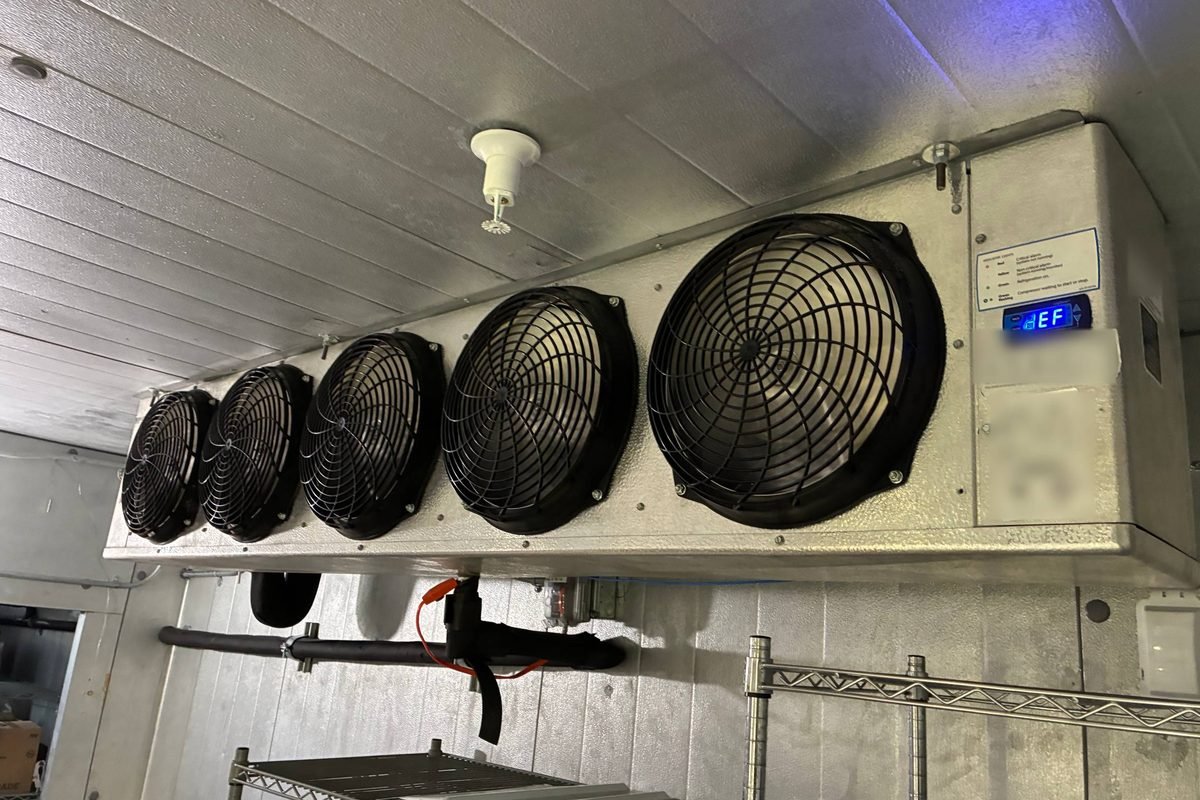
Tenn. Comp. R. & Regs. 1200-23-01-.03). - Look and listen before flipping switches: Note the box thermometer reading, whether the ceiling fans inside the walk-in are spinning, and whether frost is visible on the coil fins.
Quick Diagnostic Table: Symptom vs. Cause vs. Safe Action
Use this symptom matrix to separate a 10-minute housekeeping fix from a mechanical or sealed-system failure that needs a commercial refrigeration technician:
| Symptom You Observe | Most Likely Root Cause | Safe 10-Minute Owner Check | When to Call JW HVACR |
|---|---|---|---|
| Door display reads 45°F–50°F right after truck load, then drops | Normal recovery pull-down after warm air infiltration during restocking | Latch door shut for 20 minutes and check an interior shelf thermometer | Box fails to pull down toward 35°F–38°F after 30 minutes with the door closed |
| Condensation around doorframe or door hangs 1/4" ajar | Split magnetic door gasket, sagging hinge, or worn automatic closer (10 CFR § 431.306) |
Run the dollar-bill tug test around all four edges of the door seal and clear floor mats | Door frame is racked, closer has lost tension, or humid air has already iced the coil |
| Ceiling fans spin inside box, but airflow feels weak | Stock cartons stacked against return grille or frost bridging the evaporator fins | Pull boxes at least 6 to 12 inches away from the ceiling unit intake and fan guards | Evaporator face is packed with solid frost or clear ice (never chip or pry the fins) |
| Ceiling unit inside the walk-in is completely silent and dark | Tripped circuit breaker, open disconnect, failed fan motor, or stuck defrost clock | Check the electrical panel; if a breaker tripped, flip fully OFF and reset once only | Breaker trips a second time, or fans stay off with power on (OSHA 29 CFR § 1910.303) |
| Outdoor condensing unit runs hot and clicks off every few minutes | Condenser coil matted with grease, dust, or cottonwood lint driving up head pressure | Shut off disconnect first; gently brush loose outer leaves/paper off intake louvers | Compressor still short-cycles on high-pressure cutout, fan motor is seized, or coil needs degreasing |
5 Safe Checks You Can Run in 10 Minutes (No Tools Required)
1. Compare Actual Product Temperature Against the Door Thermometer
Doorframe dial thermometers and exterior digital displays measure air right next to the doorway—the warmest spot in the walk-in. Whenever your crew opens the door during line prep, warm kitchen air washes over that sensor and spikes the readout for 10 to 15 minutes even when product on the shelves is still cold.
- Check a standalone spirit or calibrated digital thermometer placed on an interior shelf away from the doorway.
- Under FDA Food Code
§ 3-501.16(A)(2)and Tennessee Rule1200-23-01-.03(5)(a)6.(i)(II), cold-held TCS food must remain at 41°F (5°C) or below. Commercial walk-in coolers are typically set for 35°F to 38°F air temperature so food cores stay safely under 41°F during normal door traffic.
2. Inspect the Door Gasket, Latch, and Automatic Door Closer
Warm, humid kitchen air leaking past a worn door seal is the #1 preventable cause of iced-up evaporator coils. Federal U.S. Department of Energy (DOE) Walk-In Cooler and Walk-In Freezer Standards (10 CFR Part 431 Subpart R, § 431.306) require automatic door closers, perimeter gasket seals, and high-density insulation (minimum R-25 for coolers, R-32 for freezers) specifically because air infiltration swamps the evaporator with latent moisture.
- Latch & closer check: Let the door swing shut on its own and confirm the hydraulic closer pulls the latch all the way home without bouncing open.
- Dollar-bill test: Close the door on a dollar bill along the top, bottom, hinge side, and latch side. If the bill slides out without firm drag, humid air is pouring into the box 24 hours a day.
- Threshold check: Make sure floor mats, mop buckets, or dunnage racks aren't holding the bottom vinyl sweep ajar.
3. Confirm Evaporator Fan Airflow and Clear High-Stacked Boxes
The ceiling evaporator unit pulls warm air in across its finned coil and discharges chilled air across the top of the box. When delivery cartons are stacked flush to the ceiling in front of the fans or pushed tight against the rear return grille, cold air short-cycles right back into the intake while the rest of the walk-in warms up.
- Open the door briefly and verify all evaporator fan blades are spinning smoothly without scraping or rattling.
- Keep at least 6 to 12 inches of clear space below, in front of, and behind the ceiling unit.
4. Shine a Flashlight on the Evaporator Coil Fins for Sheet Ice
Look through the fan guards or rear louver of the ceiling unit. A light, even dusting of frost right before a scheduled defrost cycle is normal. A solid sheet of white snow or clear ice bridging the aluminum fins stops airflow cold—even if the compressor runs nonstop, air cannot pass through solid ice to give up heat.
- Never chip, scrape, or torch ice off an evaporator coil. The coil's thin-wall copper tubing holds pressurized refrigerant. One slip with a screwdriver, knife, or heat gun punctures a tube, venting the refrigerant charge and turning a defrost or airflow repair into a full evaporator replacement.
5. Check for a Tripped Breaker or Blocked Outdoor Condenser
Every BTU of heat pulled out of your walk-in cooler has to be rejected through the condensing unit (located outdoors, on the roof, or in a mechanical area).
- Electrical breaker check: Inspect your labeled breaker panel. If the walk-in breaker has tripped, switch it fully OFF and reset it one time only. If it trips a second time, leave it OFF—repeatedly resetting a breaker into a shorted compressor winding or grounded wire creates a severe arc-flash and fire hazard (OSHA
29 CFR § 1910.303). - Condenser intake check: If the condensing unit is safely accessible at ground level, verify that cardboard bales, grease barrels, or storage racks aren't blocking airflow. Shut off the local disconnect switch before brushing loose outer leaves or paper off the intake louver (OSHA
29 CFR § 1910.147).
- Federal EPA Section 608 Certification Mandate (
40 CFR § 82.161&§ 82.154): Refrigerant circulates in a sealed loop and never "burns off" during normal operation—low charge always means a leak. Federal law requires EPA Section 608 Technician Certification for anyone attaching gauges or opening a refrigerant circuit and strictly prohibits knowingly venting refrigerants. - EPA AIM Act Commercial Leak Repair Rule (
40 CFR § 84.106, effective Jan 1, 2026): Commercial refrigeration appliances holding 15 pounds or more of an HFC or substitute refrigerant (GWP > 53) are subject to a mandatory 20% annual leak-rate limit, leak-rate calculations whenever refrigerant is added (§ 84.106(b)), leak repair and initial + follow-up verification tests within 30 days (§ 84.106(d)–(e)), and 3-year recordkeeping (§ 84.106(l)). - High-Voltage Electrical & Metering Diagnostics (
OSHA 29 CFR § 1910.147 / .303): Commercial condensing units and defrost circuits carry120V / 208–240V / 460Vpower and start capacitors that hold dangerous voltage after shutoff. Diagnosing contactors, relays, liquid-line solenoid valves, and thermostatic expansion valves (TXVs) requires calibrated superheat/subcooling instruments and lockout/tagout protection.
Verifiable Technical & Regulatory Sources Cited in This Guide
- Tennessee Department of Health — Food Service Establishments (
Tenn. Comp. R. & Regs. 1200-23-01-.03(5)(a)6.(i)(II)): State mandate requiring cold-held TCS food to be maintained at 41°F (5°C) or below. Read TN Regulation (Cornell LII) - U.S. Food & Drug Administration (FDA) — Food Code (
§ 3-501.16): Federal public-health standard for cold holding (41°F / 5°Cmaximum) and thermometer placement in commercial refrigeration. Read FDA Food Code - U.S. Department of Energy (DOE) — Walk-In Coolers & Walk-In Freezers Standards (
10 CFR Part 431 Subpart R, §§ 431.301–431.306): Federal thermal insulation (R-25coolers /R-32freezers), automatic door closer, and infiltration rules. Read 10 CFR Part 431 Subpart R (eCFR) - U.S. Environmental Protection Agency (EPA) — Clean Air Act Section 608 (
40 CFR Part 82 Subpart F, §§ 82.154 & 82.161): Mandatory technician certification and venting prohibition for commercial refrigeration service. Read 40 CFR § 82.161 (eCFR) - U.S. Environmental Protection Agency (EPA) — AIM Act Subsection (h) Leak Repair Rule (
40 CFR Part 84 Subpart C, § 84.106): Mandatory20%annual leak-rate threshold and30-dayrepair/verification requirements for commercial refrigeration systems with ≥15 lb charge. Read 40 CFR § 84.106 (eCFR) - Occupational Safety and Health Administration (OSHA) — Electrical Safety & Lockout/Tagout (
29 CFR §§ 1910.147 & 1910.303): Federal electrical enclosure and hazardous energy control standards. Read 29 CFR § 1910.303 (eCFR)
Need Commercial Walk-In Cooler Repair in the Knoxville Area?
If your walk-in cooler is holding above 41°F, icing over, or short-cycling, JW HVACR LLC repairs commercial walk-in coolers, walk-in freezers, reach-ins, and ice machines across Knoxville, Powell, Oak Ridge, Maryville, Alcoa, Farragut, Sevierville, and surrounding East Tennessee communities within a 60-mile radius.
Office hours are 8:00 AM–5:00 PM Monday–Friday, with after-hours emergency service available when commercial cold storage cannot wait.